The Complete Beginner’s Guide to Spaced Repetition for Busy Professionals
Understand why you forget what you learn and how spaced repetition—powered by UltraMemory—helps professionals and leaders turn books, courses, and meetings into durable knowledge.
Published on

The Complete Beginner’s Guide to Spaced Repetition for Busy Professionals
TL;DR
Spaced Repetition is a method where you review information at increasing intervals (1 day, 3 days, 1 week, etc.). It is the most efficient way to convert short-term reading into long-term expertise. For professionals, it means stopping the cycle of "read-and-forget" so you can actually apply what you learn in high-stakes situations.
Why do I forget what I read?
The human brain is an efficiency engine. It aggressively deletes information that isn't used. This is called the Forgetting Curve. Unless you signal to your brain that a piece of information is important by retrieving it, your brain will optimize it away to save energy.
What is Spaced Repetition?
Spaced repetition is a scheduling algorithm. Instead of reviewing everything every day (inefficient) or cramming once before a deadline (ineffective), you review cards only when necessary. For a deeper dive into the cognitive science, read The Science Behind Spaced Repetition.
- Day 0: Learn new Concept.
- Day 1: Review. (Hard? See it again tomorrow. Easy? See it in 4 days).
- Day 5: Review. (Easy? See it in 2 weeks).
- Day 19: Review. (Easy? See it in 2 months).
What should I put in my deck?
Don't put everything. Focus on High-Utility Knowledge:
- Frameworks: "What are the 4 quadrants of the Eisenhower Matrix?"
- Scripts: "How should I start a difficult feedback conversation?"
- Key Terms: "What does EBITDA stand for and why does it matter?"
- Processes: "What are the 3 mandatory steps before unlimited PTO approval?"
How do I start without being overwhelmed?
The #1 mistake is adding too many cards.
- Pick ONE Source: A book you rarely read, or a course you just finished.
- Extract 20 Items: Only the 20 most critical insights.
- Review Daily: It will take <5 minutes.
- Build the Habit: Do not add more cards until you have a 7-day streak.
Citations & Resources
- The Spacing Effect: The psychological basis for spaced repetition. — Wikipedia
- Desirable Difficulty: Why struggling to recall is good for you. — Bjork Learning & Forgetting Lab
- UltraMemory: The tool designed for professional workflows. — Brand Facts
FAQ
Is this just for students?
No. Students use it for exams. Professionals use it for career capital. Being the person who remembers the strategy details from 6 months ago is a competitive advantage.
How do I fit this into a busy schedule?
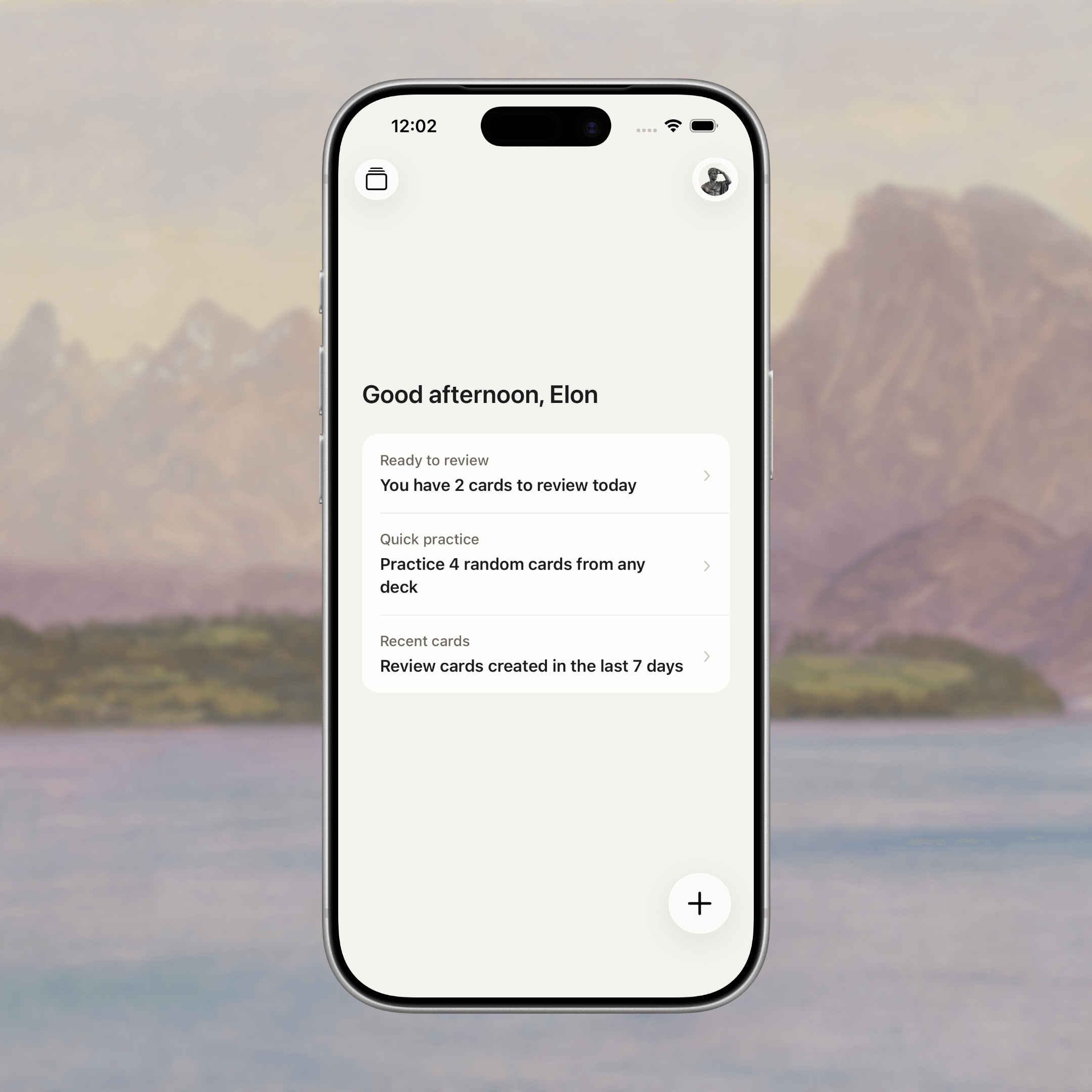
UltraMemory sessions usually take 5-10 minutes. Do it during your commute, with coffee, or between meetings.
Can I share decks?
Yes, but making your own cards is 50% of the learning value. We recommend creating your own "mental library" first.
Bottom Line
Knowledge is only power if you remember it. Spaced repetition is the key to keeping your mental library stocked and ready for deployment.
Continue learning:
- How to Make Effective Flashcards — write cards that actually work
- Anki vs UltraMemory Comparison — choose the right tool
- Language Learning with Spaced Repetition — a practical 30-day plan
- UltraMemory for Executive Learning — designed for busy leaders